LINK TO FILES ON GOOGLEDRIVEFURTHER WRITING EXPERIMENTS |
TIMELINE
CREATING NARRATAGE (NARRATIVE-COLLAGE)
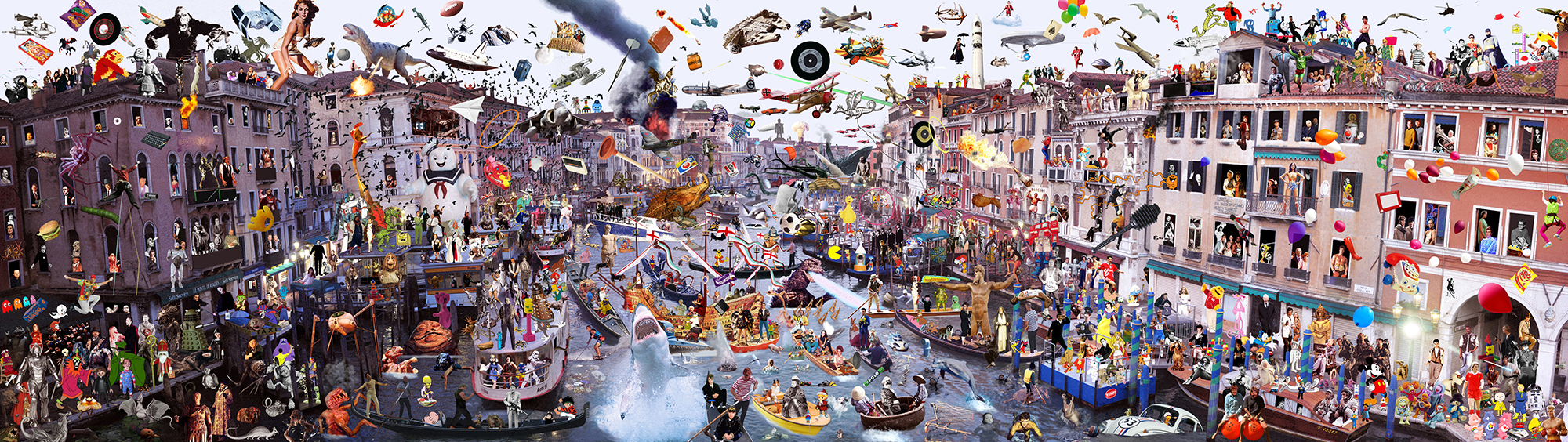
The back story to this project, involves my recollections on notions of Bob Dylan’s Nobel Banquet speech (Dylan, B 2016). where he talks about how stories can be merged, and mixed with lived experience to create songs, and there was appetite created here, to do something similar with my PHD story writing, not with songs, but with images and words. Also, his sentiments seemed to very much relate to the classic essay, Tradition and the Individual Talent by Eliot (Eliot, T, S, 1919). Another significant back story experience was of creation of hyperlinks during the construction of my artist website www.johnson-perkins.co.uk (Johnson, Perkins, J, 2022) and my further musings on this, as being an interesting way, to connect source materials, allowing a reader of website material to understand narratives and ideas in new and multifaceted ways, that perhaps have all become so normalized to us today.
This PHD investigation begins with an interest in how one could translate images made as part of my Artist practice from ‘2009-’, into a series of short-stories. These initial images that I wanted to translate in a new way were fuelled by historic themes/taxonomies, that in themselves, were updated, by transposing (COLLAGING/MONTAGING) many images that relate to particular themes. So, for example in the first image ‘The Great Battle’. It uses the theme of Morality and ‘Good versus Evil’, Here, It also References Bruegel’s ‘Fight between Carnival and Lent’, and the image is set in Canalletto-esque Venice. This has added (MONTAGED) characters from my memory and that were sourced by internet search engine finds, such as, Good characters comparable to Luke Skywalker and a bad-ones, like Darth Vader. (Lucas, G, 1977-83).
As a way of introduction, I want to state that my background isn’t in Creative writing. I have an artist background and I studied Fine Art, not English, but I have always considered writing as something that has parallels, and I have always enjoyed the idea of Writing itself as Art, and I have always had a deep interest in how art and writing connect and relate to each other? So, this led to the preliminary interest in the scope of this writing project with taking my Digital Montaged (GIGATAGE) images and somehow turning them into short stories, and to start this process I wanted my protagonist of the first story to be me, imagining myself inside this corresponding collaged scene, with written memories sourced from previous visits to Venice, and I wanted to create a narrative that was influenced by these two aspects. Therefore, when creating this first story, my realization was that there are various links between things. Links between the characters in the image and myself, and also inherently between the good and bad characters pictured. Also, there could be intrinsic connections where parts of a story link the two separate areas of image using ideas pertaining to Psychological Dark and Light triads. (Kaufman S, B, 2019)
These four different elements are all part of this research
-
Gigatages
-
Critical reflection
-
Website
-
Stories
Gigatages
My Gigatage series of ultra-large scale digital works use Gigapan technology and Montage. Here, I have created landscapes of different modern and historical figures in renowned sites and civic squares, and the five main Gigatages that form the backdrop of my series of stories are based in Venice/Italy, Beijing/China, Kathmandu/Nepal, Moscow/Russia and New York/USA. They explore different themes and ideas, related to: Ethics/Canaletto, Plagues/The Four Wise Monkeys, Religion/Raphael, War/Noah’s Ark and Consumerism/ Hieronymus Bosch respectively. In each of the different scenes there is a taxonomy with as many characters I could find on the internet, which, relate to the pictures/themes and Ideas. E.g., All of the…Good and Bad characters from my history that I could think of, People whom have had their senses messed with, Images of Deities and religious items, Animals, and Crazy/Mad and Radical people.
Critical Reflection
The critical Reflection in this timeline is a way for me to understand my writing processes, and how they relate to different thematic areas which pertinent to my idea of a NARRATAGE, which I will explain later. This reflection itself contains multiple hyperlinks, linking different areas in this website, which I want the reader to look at if they wish, but which I am also relating back to as well.
Website
When creating a second mind map to help me understand my researched materials on 18/9/2021 I realised, that my research was falling into various categories. EXPRASIS, HISTORICALITY, APPROPRIATION, RESTRAINT, EXPERIMENTATION, HETERGENEITY and HYPERTEXTUALITY, and it was shortly after this time that it was mooted that I could perhaps collect and show my research in a more non-linear manner, because my research was very scatological and Collage-y in itself. I realised at this point that I wanted it to also relate/and connect my/these stories to different media as such as images, websites, videos; as well as books, essays and papers. Therefore, I decided at this point to create a work in process website (http://johnson-perkins.co.uk/phd.html) (Johnson-Perkins, J, 2022) covering these categories stated. Also, in this text itself, you there are CAPITALISED, Blue and BOLD references, and these connect to multiple website pages with further research materials, and I found these elements very useful in helping me to contextualise parts of my stories and research, as I am continuously doing it, and also when I have been thinking about future writing as well.
Stories
In 2018 I presented a lecture at the China Academy of Art, Hangzhou, China, on my ‘Gigatage’ works, and afterwards I had a conversation that made me realise that I wasn’t talking about them and describing them very well. Basically, I was explaining how they were made and the conceptual underpinning of them, but I had little knowledge about the Narrative or Narratives that they were alluding too or could allude to. These ‘Gigatage’ works that I had created, felt at this time somehow ‘out of my control’ in the sense that I couldn’t fully gasp their impact, which is not at all surprising perhaps, because of their size and magnitude, and also because the amount of time they take to make, and the amount of different elements therein. E.g., The Great Battle has taken me over ten years to complete and with its many many different characters.
At this time, I deliberated, how could I better understand these works in a deeper and meaningful way? I thought, perhaps I could write about them, or maybe I could create a story about each one? and that perhaps these Narrative/stories could explain/bookend or be companion pieces of my ‘Gigatage’ images, and somehow complete them in some way? and maybe this would help me to grasp their impact more fully, therefore this was impetus that has also led me to do this PHD study at Creative Writing at Lancaster University.
STORY 1 – THE GREAT BATTLE (2018-19)
A great deal of forethought about my first image and story went into in deciding how I could create a process of working, and how this would be linked to the internet and technology? Charlie Gere’s book ‘Art, Time and Technology’ (Gere, C, 2006), informed early thinking on this, leading to my fascination with Samuel Morse, whom he discusses therein. I made a creative decision, that I would use Morse and that he would be linked into my story, as a character, and I thought it also made sense, to not only use him as a personality here, but also to incorporate Morse-Code itself in my story as well, as my thinking was that this could break up the story in an exciting way. This became one of the many experiments, of adding unusual source materials (like morse code) to mess with, or glitch with, my stories.
As well as this, Initially the in-built art processes of the Gigapan images themselves were also explored, leading to the fundamental questions in this research, that of: How can one replicate an experimental image Montage art-making processes using writing? And, what are all the different ways that one can do this?
Akin to the ‘The Great Battle’ image, the first NARRATAGE story uses characters from this picture and the location is also hosted within the written narrative. These are mixed with nostalgic memories, which were written in the first person.
At the beginning, I decided to choose a different story type, for each of my five stories, using one from one of Christopher Brookers Seven Basic Plots. Booker believes, that there are seven story types in the whole of literature, theatre and film.
- Overcoming the monster
- Rags to riches
- The quest
- Voyage and return
- Comedy
- Tragedy
- Rebirth
For this first story, I used a 'Rebirth' type, because this I thought lent itself well to the ethical taxonomy explored in ‘The Great Battle’ image itself. The characters in this first story are taken from this image, and interjected into the story where they interact with a main character, assumed to be the me.
Initially this had a form that was considered to be my (The Artist) own voice but quite soon into the writing process, the notion of What voice was being used? sparked a considerable amount of discussion. Initially, I found conversations around ‘Voice’ unsettling as this was very much outside of my comfort zone, because as an Artist, one rarely considers this factor. It seems to me that usually Artists differ from writers, in that they think What does an artwork mean? and What does it communicate? but rarely, if at all, What voice is being used or what voice should one use? Therefore, this fact was heavily deliberated in my writing until an understanding of ‘Voice’ in writing was further understood, and this became a significant factor in the creation of this subsequent Narrative story sequence. Where, notions of ‘Voice’ are unpacked, and not just understood as being just there, but are being carefully considered and explored.
Because my first assumption was I would always use my own voice, the initial approach used was derived from remembrances of Venice and real life-events that were tweaked and further contemplated, and this soon led to a shift in thinking about the possibilities of using a multitude of written Voices. Where there is a transferal, from “whom am I?” to “whom could I be?” and also, How can/should personal; writing/notes/memories relate to other texts?
An early recommendation for this PHD process, was to explore notions of EKPHRASIS, and historical ideas which pertain to: changing images into words. Using a rhetorical device to define form and essence, where one medium of art attempts to illuminate and relate to another. This specifically led me to think about popular literature, inspired by art or paintings, such as Girl with a Pearl Earring by Tracey Chevalier (Chavalier, T, 2000). Here, the writer tries to imagine the life of a Girl from a Vermeer painting, and the author sets this character in a historical place, based on where and when, the painting was made. To be honest, from the very beginning, I thought that this kind of writing style, is too obvious and really Naff approach to re-contextualizing an artwork, and not at all what I wanted to do in my project. Therefore, I thought of more interesting approaches, such as in Oskar Wilde’s, the Picture of Dorian Gray (Wilde, O, 2003). Here the painting/art is treated very differently. It being, inside the story itself, unlike with Chevalier’s work which imagines a storyline or life events inspired by a real person that was painted. With Wilde’s work it’s more about what paintings do to people, and how they can capture, mirror and skew reality. Therefore, this feels like a much better proposition becuase it is a more complex idea, in terms of a characters relationship to an artwork itself. At this early time in my PHD writing, I also thought, Wilde's story also had surreal parallels to Alice in Carol’s Wonderland (Carol, L, 2015), because it plays on and skews with ideas about place and time as well. Therefore, It seemed pertinent to introduce some of the facets of Alice in Wonderland, and some that related to time shifts, in into my first story as well.
Another recommendation for this PHD research was to explore ideas relating to RESTRAINT and PROCESS. Beginning with Oulipo, the pioneers of experimental writing that very much adopt these aspects. I saw that this group somehow twinned with Fluxus ideas, that I was already very much aware of because of my Artistic background and previous research (e.g. I had done an artist Residence with a Fluxus Gallery). Here, I could see similarities with how Fluxus artists used restraints, using scores which limit/effect how work is made. Also, I knew that artists such as John Cage and the Black Mountain group were similarly concerned with concepts/games/working restraints. Famous Oulipo works are: Raymond Queneau’s One Hundred Thousand Billion Sonnets and Perec’s Void (Perec, G, 2005), where the letter E isn’t used. Notions of what art/writing can be, and creating and breaking constraints are central here and I could also see links with Josephs Beuys notion that art can be anything, (Buschkühle , C, 2020) and his concept of social sculpture (blackboards) seem prescient here, as another unusual/interesting expression of writing.
Inspired by Motte’s book on Oulipo (Ed. Motte, W, F, 2015), and in sympathy with this experimental writing group, I decided to create a set of writing rules/restraints for my first story to inform a writing process.
All writing should be closely related to the GIGATAGE image (ideas inherent) and actual things that have happened in my life. Or fantasies based on actual events.
The main character in each section of the story is ME and has my name.
Each section of the story (5 sections) should follow a different story type. E.g., Redemption…
Write as much as possible.
Select book/s per section as key influence/s. Different books for different sections.
When stuck for ideas expand on the different stories with unusual (technology) inspired writing sections. E.g., Emails, Twitter feeds, Facebook pages, Morse code, Telegram…Play with time here.
Remember you are not a writer you are an artist. So, keep writing very simple, be yourself. Try in as much as possible to write as I would talk and how I think others I know would/do talk (write what I think they could say). Do not create characters that are outside my actual world I live in.
Merging two different people is highly encouraged. (And Compulsory at times as, you will offend)
Don’t worry about continuity between the five different chapters/sections. Actually, they will connect. It will be interesting to see how they do, when the story is finished. Remember these stories don’t have to follow the stereotypical mould of story writing. INVENT, EXPERIMENT, PLAY
Use the internet as the main source for material, however when stuck for things to write, it is totally acceptable to look for random book/s (including actual books) for sections of stories that could be added, or talked about in the story. (Thinking of Burroughs cut-up technique, the randomness will be fun and unexpected)
Include information regarding one relevant historic artist/person per section (e.g., something they did, in their life.) into the text.
Try and shock yourself in the narrative. Play with notions of who I am and at times try to create unacceptable and funny versions of myself. (Allow yourself to have dissonant resonance, as you don’t often in real life)
Keep looking at these instructions, and remove anything that doesn’t follow them. Be very strict with this.
In Comparison, here it became clear that Oulipo’s rules are more restrictive, e.g. In the way that Georges Perec writes an entire novel without the letter ‘e’. However, I found these initial writing rules to be a useful way of planning how to write something and I also was able to also apply some restrictive elements, similar to Hemmingway’s rules. Such as that: One should always use Vigorous English. (Hughes, D, H, 2022)
After constructing these rules, a suggestion was made, that I should think more like an artist, and treat the words as a material, like painting pixels, to be manipulated. (Akin to the Gigatages themselves) and this led to another shift in thinking, on how to link the process of writing to parallel processes in my Gigapan images themselves, and to use more montaged elements as well, and then it became abundantly clear to me that this first text I had written wasn’t very Collage-y at all in terms of using other writers (appropriated and collaged) words.
At this point the writing processes were still being developed, both during and within the writing itself. However, these initial writing experiments did allow for this comparison to aspects of prior art practice, and this became a way to think about how my previous art processes could also be more clearly conveyed in this PHD story sequence. At this point I had, experimented with different aspect, like with the use of Morse Code, Inserted imagery and investigations into time shifting elements (past-present-future) in the first story, and I think these do provide a curious way to play with/inside a story text, but ultimately this first story is overly formal and it needs much more creative development and consideration.
During the writing of this first story there was also research into Kenneth Goldsmith work, a re-reading of Roland Barthes ‘Death of the Author’ (Barthes, R, 1977) and Walter Benjamin’s The Work of Art in the Age of Mechanical Reproduction’, (Benjamin, W, 1968) Salmon Rushdie’s ‘Haroun and the sea of stories’ was revisited (Rushdie, S, 1991), William Burrough’s, David Bowie and Brion Gysin interviews were watched and I read some of George P. Landow writing on Hypertexts (Landow G, P, 2006) and about different Oulipo practices. Alice in Wonderland was re-read (Carroll, L, 2016), and there was an enquiry into dark (antisocial) and light (prosocial) traits. Therefore, of these ideas and elements were gleaned and channelled into this writing.
In the GIGATAGE image, there is a landscape (site) where characters from internet image searches are added. These images are of people characters that are appropriated from different stories (films, cartoons, etc.) The collage elements of the image, are freely and digitally cut and pasted (Ctrl C / Ctrl V) to invent a playful visual story of sorts. Ultimately in the Gigatage image there is a taxonomy of related collected sources.
After all of my initial reaserch I began to realise that these PHD stories could push in a similar direction, and I could use texts that are also similarly taxonomically related, and that I could use appropriated text (instead of images) to add to and play with in the creation of a Narrative place (site). NARRATAGE.
STORY 2 – THE THREE IDIOT MONKEY’S (2019-20)
- Overcoming the monster
- Rags to riches
- The quest
- Voyage and return
- Comedy
- Tragedy
- Rebirth
This second story utilized an ‘Overcoming the Monster’ story type (Brooker, C, 2019) and it’s more Collage-y in terms of using other writers appropriated words in sympathy and parallel with the GIGATAGE collages themselves. I began to refer this writing as NARRATAGE and this word-play and new approach somehow provides a clearer focus where the research is more honed, and focused more on notions of collage and collage-ness within the writing itself.
Given the state of the world at the time of writing story two, due to Cov-19, this coincidentally related very succinctly with The Three Idiot Monkey’s image that I had recently completed. This GIGATAGE image is based on the Three Wise Monkeys, the Japanese pictorial maxim, which embodies "see no evil, hear no evil, speak no evil".
 press2.jpg)
In this story, there is a more conscious use of APPROPRIATION and of the use of a selection of found writings which pertain to the image itself. This includes elements relating to: plagues, pandemics and of ‘end the world traumas/scenarios’ and found written elements about are assembled and collaged into different areas of this second text. It uses first hands accounts of Covid-19 experiences mixed with: excerpts from Daniel Defoe’s “History of the Plague in London” (Defoe, D, 2012), public Messages from Social media, clips from Jean-Jacques Rousseau. “The Social Contract & Discourses” (Rousseau, J, 1993) and from Friedrich Engels “The Condition of the Working-Class in England” (Engels, F, 2009) and it also uses parts derived from HG Wells. “The War of The Worlds” (Wells, H, G, 2019).
Here there was a definite process of learning by Praxis where new ideas, experiments and theories were also being continuously introduced to this story as it was being written. Initial experiments instigate more research and allow for the continuous examinations into different experimental writers/artists, which are then to utilized in real time, by collaging these, as well, into the writing.
After reading Kathy Acker for the first time (Acker, K, 2018), she has become a touchstone, and major influence, contributing my realization that I can use, and collage, absolutely anything want into a Narrative in whichever way I want, also I see this as relating perfectly with Kenneth Goldsmith’s adage that “It’s not plagiarism in the digital age – it’s repurposing.” (Goldsmith, K, 2011) and I have understood now that the rules of writing, can be messed with, fought with and broken in countless creative directions, and I think that Acker’s work given me the kind of permission I needed to use other people’s work/writing, which incidentally also has allowed for a deeper exploration of new notions of ‘Voice’, and ‘Multi-Voice.’
“ACKER: I can’t remember who or what I saw and who I was influenced by until it comes to the Metro Pictures times. Then I know like Richard Prince’s work and Sherrie Levine’s work and David Salle’s work really influenced me…
ACKER: … And then when I read, I think it was mainly Anti-Oedipus and then Foucault’s work, I had this whole language…And I remember thinking, Why don’t they know me! I know exactly what they’re talking about! And I could go farther, that was the big thing for me. I had a real sense, until that happened that I was like this kind of death-dumb-and-blind person for years; I just did what I did but I had no way of telling anyone about it, or talking about it. And then suddenly I had this language and I could say, Hi![…]”
Kathy Acker: The last Interview and Other Conversations
(Acker K, Scholder, A, Martin, D, A, 2019)
These words that Acker spoke here, really resonated with me, and I find It really interesting that Kathy Acker was influenced by Appropriation artists from the Fine Art field: Richard Prince, Sherrie Levine and David Salle’s and that she channels elements of Theory (Deleuze and Foucault) as well into her writing ideas, in a similar way to what I had considered about doing, because I also wanted to also further explore, and introducing other theories into my writing as well, to allow for the creation of more complex/interesting texts/writing, and this is what I have attempted to do as well in this second story.
During the second story my research also mused about the connections between Brion Gysin’s cut-up technique (Kuri F, J, 2003), and Roland Barthes ’Death of the Author’ (Barthes, R, 1977) and how Hunter S. Thompson copied Hemmingway (Jones, J, 2017). I also enjoyed reading Roland Barthes “A Lovers Discourse” (a book of collaged/appropriated writings based on LOVE), (Barthes, R, 2022) and I had a huge realization at this juncture that Barthes process here, is also a useful and pragmatic way to develop new ways of collating different ‘stories of sorts’ based on distinctive Taxonomies, and I saw a clear comparison here with how I made my GIGATAGES, but instead here Barthes is using collected words instead.
Leanne Shapton’s work (Shafton, L, 2013) also provides a key element at this juncture, allowing for a better understanding of how one can also create work with greater HETEROGENEITY. Finally, APPROPRIATION itself is further explored, via Marcel Duchamp and Kenneth Goldsmith (Goldsmith, K, 2011).
After writing this second story, I did a writing experiment. I decided to change the classic art text by Clement Greenberg’s, his 1939 Essay. 'Avant-Guard and Kitsch’ (Greenberg, C, 2022) to produce a short creative writing piece. Deep-Fried-Fakes (Frittiert-Gefälscht) and the Hey-Ho-Neo Normal (Эй-Хо-Нео Нормальный). Here I negated an old text, making everything here, into the opposite, and then I had some fun, improvising various textual ideas and thought into this as well. I think this also allowed me I think to develop a freer and more humorous approach to writing but also I cosidering how I can add honed and specific writing process into a text as well.
e.g.
A society, as it becomes less and less able, in the course of its development, to justify the inevitability of its particular forms. BECOMES A society, as it becomes more able, in the course of its development, to ignore the inevitability of its random forms.
During the writing of this second story, I also researched: Mark Amerika, Benjamin’s Arcade Project (Benjamin, W, 2002), Deleuze and Guattari’s A Thousand Plateaus (Guattari, F, Deleuze, G, Massumi, B, 1987) and Hugo Ball’s text works.
In relation to this research, I also decided, to experiment with the use different types/forms of text too, and to further explore different experimental writers/writing, such as James Joyce’s, Finnegan’s Wake (Joyce, J, 2012), Da Da and Artists books. At this point in the writing was a gathering of ideas and theories, which relate to experimental/collage/writing/art and this research offered up various connections, which were brought together using a mind map, with ideas separated into different subheadings: ABSTRACT, EXPHRASIS, HISTORICALITY, APPROPRIATION, RESTRAINT, EXPERIMENTATION, HETEROGENEITY and HYPERTEXTUALITY.
Collaged Material
Excerpts From: Daniel Defoe. “History of the Plague in London”
Wechat Public Message, Zhejiang Province
Ningbo, Public Message
Tate Archive: Papers of Kenneth Clark [c.1876–1984],
https://www.tate.org.uk/art/archive/tga-8812/papers-of-kenneth-clark
Excerpts From: Jean-Jacques Rousseau. “The Social Contract &
Discourses.”
Excerpts From: Friedrich Engels. “The Condition of the Working-Class in England.
Excerpts From: HG Wells. “The War of The Worlds”
STORY 3 – THE ASSEMBLY OF THE GODS (2021-22)
- Overcoming the monster
- Rags to riches
- The quest
- Voyage and return
- Comedy
- Tragedy
- Rebirth
This story began by utilizing a ‘Tragedy’ story type (Brooker, C, 2019) with the aim of exploring ideas pertaining to Religion and spirituality, integral to my Gigatage image itself. It also focused on Bob Dylan who is a central character in the Assembly of the God’s image. With this writing I also tried to adopt a much freer approach and the use of APROPRIATION, with found materials from a wider range of sources.
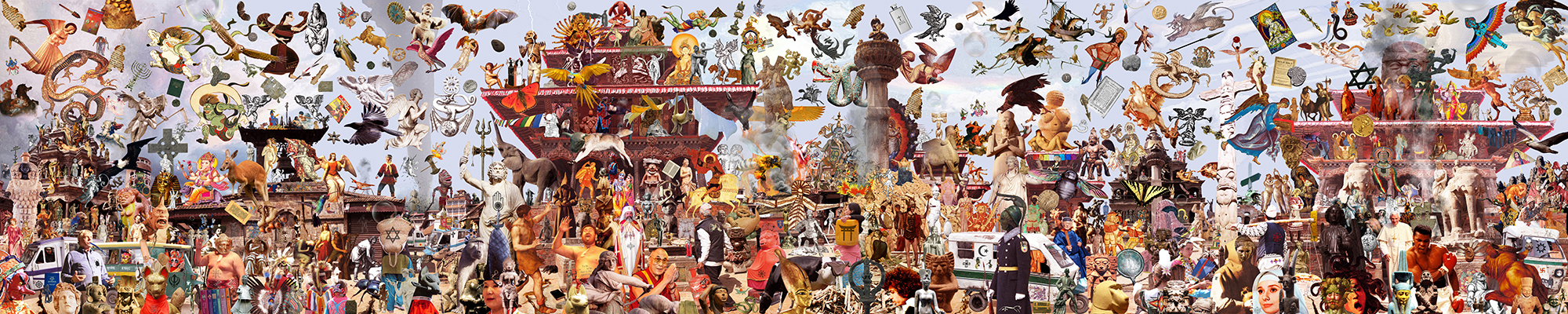
This third story mixes up writing’s differently and it is much more cacophonous. Using spiritual related texts that are experimentally mashed up, and which are purposefully, in parts, controlled and uncontrolled. In comparison to the second story where the appropriated elements are more heavily weaved and edited. In this third story they are more, laid side by side, with less consciously weaved edits.
Collaged Material
Excerpts From: John Milton. “Paradise Lost.”
Excerpts from “The Life of Buddha and Its Lessons, by H.S. Olcott.”
Excepts from The Vedanta-Sutras with the Commentary by Sankaracarya, Sacred Books of the East, Volume 1, Translator: George Thibaut
Excepts from: “Tao Teh King”, Lao-Tze.”
Excerpt from Essays in the Study of Folk-Songs (1886), Countess Evelyn Martinengo-Cesaresco.”
Excrpt From: Richard Folkard. “Plant Lore, Legends, and Lyrics / Embracing the Myths, Traditions, Superstitions, and Folk-Lore of the Plant Kingdom.”
Excerpt From: Contessa Evelyn Lilian Hazeldine Carrington Martinengo-Cesaresco. “Essays in the Study of Folk-Songs (1886).”
Excerpt From: Laozi. “The Tao Teh King, or the Tao and its Characteristics.”
Excerpt From Gertrude Landa. “Jewish Fairy Tales and Legends.”
Excerpt From: “The Vedanta-Sutras with the Commentary by Sankaracarya / Sacred Books of the East, Volume 1.”
Excerpt From: Henry Steel Olcott. “The Life of Buddha and Its Lessons.”
Excepts From: Heart of Darkness, Joseph Conrad.
Excerpts From: The Bible.
Excerpts From: Georg Bühler. “On the Indian Sect of the Jainas.”
Notes about the Gigapan, The Assembly of the Gods.
Notes written at my allotment.
Excerpt From: William Henry Doolittle. “Inventions in the Century.”
A-Rabbit, Description of Soldiers Accounts, as Soldiers leave Afghanistan.
Revised Woodie Guthrie song, this land is my land…
Notes written to and from the visits to a Chinese Dentist.
Notes written about teaching and learning experiences at work.
Notes about Politics.
Description of back pain in a hotel in China.
Excerpt From: Hiram Chase. “Two Years and Four Months in a Lunatic Asylum.”
Excerpt From: G. J. Adler. “Letters of a Lunatic / A Brief Exposition of My University Life, During the Years 1853-54.”
Random Post cards and letters, collected from Chinese internet site Taobao.
Transcripted Youtube Videos
Bob Dylan behind the scenes of the 1965 tour
Bob Dylan Interview & The Lonesome Death of Hattie Carroll
Bob Dylan Interview with Time Magazine
Bob Dylan Interviews - The Hardships of Public Image
Bob Dylan Nat Hentoff Playboy Interview
Bob Dylan on booing and walking out – 1966
Bob Dylan on conspiracy-Lenny Bruce-being born again-truth-beauty and outlaws
Bob Dylan on the Atomic Bomb- Neil Young and religion with Jann Wenner
Dylan press conference- 1986- Brett Whiteley Studio- Sydney
Meet Bob Dylan- 1986 – 4 Parts
Many of the Narrative elements relate to transcripts from Bob Dylan videos I found on Youtube, and these are mixed with scatological story elements. It uses a more experimental approach to writing and incorporates a more diverse range of elements, also given the subject matter of the Gigatage image, it has many elements derived from Holy Texts: e.g. ‘The Vedanta-Sutras’, Henry Steel Olcott’s. “The Life of Buddha and Its Lessons.”, The Bible and other interesting religious books such as Georg Bühler’s “On the Indian Sect of the Jainas.” These are collaged together with essays about Folk traditions/Songs, extracts from Conrad’s The Heart of Darkness (Conrad, J, 2022), Milton’s ‘Paradise Lost’, a re-arranged Woodie Guthrie Song (This Land is your Land) and It uses bizarre texts about lunatic asylums, Hiram Chase’s “Two Years and Four Months in a Lunatic Asylum.” And G. J. Adler’s “Letters of a Lunatic / A Brief Exposition of My University Life, During the Years 1853-54. It also features purposely unrelated postcards and letters found during its writing.
Story three, has a two-part structure where the first part of the story links with an odd and unsuccessful search for a lost ‘holy stone’, which links with my own cynical and Atheistic beliefs. In the second part, the protagonist has gone mad and the tragedy here is they are lost forever in a psychotic state, and here the text itself tries to reflect this, with both style and look. The writing here is more scatological with inserts that are derived from spam emails and notes that relate to (perhaps) unrelated events such as: recent bad experiences at work, and problematic relationships with new media here. (Zoom calls, online lectures etc.) This is also blended with other somewhat unrelated prose derived from other experiences, such as visits to the dentist, my experience of back pain and gardening notes.
After the completion of this third story sequence, this text was understandably somewhat confusing to read, (I wasn’t surprised by this), as in parts it was pretty impenetrable because there were many disjointed aspects that purposely didn’t connect. So, for example it was unclear here how the inserted images related to the text, or how Junk-email elements connected to the previous dialogue. However, even though the text was carefully curated and collated this way to create this sense of confusion, after completing this first draft the text was very confused, and I wondered whom would want to spend time trying to decipher it, and what would their pay-off be if, because ultimately, one may perhaps never make any sense of it!
At this juncture, I thought this in itself was an interesting point, and that perhaps creating a narrative that purposefully extremely hard to understand isn’t necessarily always such a negative notion! I thought that maybe it is even a good idea to purposefully write completely indecipherable texts. I also found it actually kind of funny, that this seems to me, to already be the case for narratives such as Joyce’s, Finnegan’s Wake or Pounds, Canto’s. Ultimately though, for this story, I felt that it needed more clarity and through-lines, and therefore I made the decision to separate it into two parts, and to shorten the reading experience to provide a better level of understanding and create more connections with the two-parts of this narrative, and with the Gigatage itself.
Also, during the writing of this third story I decided to create this website to host the research and findings of this PHD project (Johnson-Perkins, J, 2022), inspired by Ubu-web, (Goldsmith, K, 2022) here my Writing/Art Collage findings and relationships, are hosted and the benefits of this, are it has also allowed me to host non-words, tangential videos and music, as well as various theories and other appealing and tangentially aspects that that relate to this study. It also has a form that is more non-sequential but also more accessible in my opinion, than the use of a purely written essay style of evidence/s.
During the writing of this third story I also researched Jacques Derrida work, the Spectres of Marx (Derrida, J, 1993) and explored notions of Hauntology, I also read Mark Fisher’s ‘Capitalist Realism’ (Fisher, M, 2009) and Gilles Deleuze, Postscript on the Society of Control (Deleuze, G, 1992) and I also looked at Douglas Coupland’s writing and read JPod (Coupland, D, 2006) and I like how Coupland integrates himself into his stories, as I have done, e.g. He appears as himself in JPOD, where he annoys the protagonist and in the story he also makes many in jokes about himself, which I thought is a clever writing technique/idea.
Reading Derrida was fascinating and unsettling. To learn and think about his concept that we are haunted by the past, and that Marx's ideas/theories are a spectre, because this seems all too pervasive especially regarding current events in Ukraine. I think that many of these elements, from this recent research have seeped into the end of the 3rd story, and will also feed very sicintly into my 4th story as well.
Also, after writing this third story, I did another writing experiment. I decided to change the classic art text of Marcel Duchamp. 'The Creative Act’ (Duchamp, M, 2022 (1957)) to produce another short creative writing piece. The Uncreative Act. Here again I negated this old text, making everything here, into the opposite, and in this case there are improvised elements derived from the notes I have started making for the fouth story, which relate to the war in Ukraine.
References
Acker, Kathy, Great Expectations, Penguin Classics, 2018.
Acker, Kathy, Kathy Acker: The Last Interview: and Other Conversations (The Last Interview Series), Scholder, A, Martin, D, A, Melville House, 2019.
Barthes, Roland, Image, Music, Text, pp.142-148, Fontana London, 1977.
Barthes, Roland, A Lover's Discourse: Fragments by Roland Barthes, Vintage, 2022.
Benjamin, Walter, Illuminations: Essays and Reflections. Ed. Hannah Arendt. Trans. Harry Zohn. Benjamin, Walter, The Arcades Project, Belknap Press: An Imprint of Harvard University Press, Schocken Books, New York, 2002 (1968).
Boulter. Amanda, Writing fiction: creative and critical approaches, Red Globe Press, 2007.
Brooker, Christopher, The Seven Basic Plots: Why we tell stories, Bloomsbury Continuum, 2019.
Bulgakov, Mikhail, Diaries and Selected Letters, Alma Classics, 2016.
Burrough, William. Cities of the Red Night, New edition, Picador, 1982.
Buschkühle , Carl-Peter, Joseph Beuys and the Artistic Education Theory and Practice of an Artistic Art Education (Doing Arts Thinking: Arts Practice, Research and Education), Brill | Sense, 2020.
Carol, Lewis, Alice in Wonderland, Puffin Books, 2015.
Chavalier, Tracy, Girl With a Pearl Earring, Dutton Adult, 2000.
Coupland, Douglas, JPOD, Random House of Canada, 2006.
Curtis, Adam, Dir, Hypernormalisation, BBC, 2016
Defoe, Daniel, History of the Great Plague in London: A Journal of the Plague Year Being Observations, Ulan Press, 1665.
Deleuze, Gilles, Postscript on the Societies of Control, October, Vol. 59 (Winter, 1992), pp. 3-7, The MIT Press, 1992.
Derrida, Jaques, Spectres de Marx, Routledge, 1993.
Duchamp, Marcel, Art History Project Website, 2022 (1957), Available from: https://arthistoryproject.com/artists/marcel-duchamp/the-writings-of-marcel-duchamp/the-creative-act/ > [15 March,2022]
Dylan, Bob, Nobel Website, 2016, Available from: <https://www.nobelprize.org/prizes/literature/2016/dylan/speech/> [15 March,
2022]
Eliot, Thomas, S. 1919 Perspecta, Vol. 1, pp. 36-42, The MIT Press, 1982.
Engels, Friedrich, The Condition of the Working Class in England (Oxford World's Classics), Oxford University Press, 2009.
Fisher, Mark, Capitalist Realism, Zer0 Books, 2009.
Gebbie, Vennesa, Short Circuit: a guide to the art of the short story, Salt Publishing, 2009.
Gere, Charlie, Art, Time and Technology, Berg Publishers, 2006.
Goldsmith, Kenneth, Uncreative Writing: Managing Language in the Digital Age, Columbia University Press, 2011.
Goldsmith, Kenneth, Ubuweb Website, 2022, Available from: < https://www.ubu.com/ >[17 April, 2022]
Greenberg, Clement, De Gruyter Website, 2022, Available from: <https://www.degruyter.com/document/doi/10.1525/9780520340770-005/html>[16 April, 2022]
Guattari, F, Deleuze, G, Massumi, B, A Thousand Plateaus: Capitalism and Schizophrenia, University of Minnesota Press, 1987.
Hughes, D, H, Velocity Writing Website, 2022, Available from: < https://velocitywriting.com/hemingways-four-rules-for-writing/ [16 April, 2022]
Johnson, Perkins, James, Artist Website, 2022, Available from: <https://www.johnson-perkins.co.uk/> [15 March,2022]
Johnson-Perkins, James, PHD Website, 2022, Available from: < http://johnson-perkins.co.uk/phd.htm>[17 April, 2022]
Jones, Josh, Open Culture Website - Literature, Writing, 2017, Available from: <http://www.openculture.com/2017/06/hunter-s-thompson-typed-out-the-great-gatsby-farewell-to-arms> [16 April, 2022]
Joyce, James, Finnegans Wake (Wordsworth Classics), Wordsworth, 2012.
Landow, George, P. Hypertext 3.0: Critical Theory and New Media in an Era of Globalization, JHUP, 2006.
Kaufman Scott, B. Scientific American, Springer Nature, March 2019.
Kierkegaard, Soren, Part I: Either/Or. Princeton University Press, 2013.
Kuri Jose F. Brion Gysin: Tuning in to the Multimedia Age, Thames & Hudson, 2003.
Lyons, Minna, The Dark Triad of Personality: Narcissism, Machiavellianism, and Psychopathy in Everyday Life, Academic Press, 2019.
Lucas, George, Dir. Star Wars (Trilogy), 20th Century Fox, 1977-83.
North, Sam, Five analogies for fiction writing, Gylphi Limited, 2014.
May, Charles, E. The New short story theories, Ohio University Press, 1994.
Motte, Warren, F. Oulipo: A Primer of Potential Literature, Dalkey Archive Press, 2015.
Perec, Georges, A Void Paperback, David R Godine; Verba Mundi edition, 2005.
Rousseau, Jean-Jacques, The Social Contract and The Discourses, Everyman's Library, 1993.
Rushdie, Salmon, Haroun and the Sea of Stories, Granta Books/Penguin, 1991.
Sanders. Julie. Adaption and Appropriation, Routledge, 2008.
Shafton, Leanne, Swimming studies, Penguin Books, 2013.
Wells, Herbert, G, The War of The Worlds, Penguin Classics, 2019.
Wilde, Oscar, The Picture of Dorian Gray, Penguin Classics, 2003.
STORY 4 – Mother’in-law’land
This story utilizes a ‘Voyage and Return’ story type (Brooker, C, 2019) and is aimed at exploring ideas pertaining to War, integral to the Gigatage image itself. It also focuses my experiences in Moscow, during a tumultuous period in my life from 2012. This story focuses of my life in Russia, on my Marriage to my Siberian Wife, and how the war in Ukraine has affected my life and Family. It also focuses on my views on Russia and the current Authoritarian Regime. This work returns to a more paired down Collage-y style, similar to story 2 in terms of it using other writers appropriated words in sympathy and parallel with the GIGATAGE collage itself, but in this story, I was also looking at new ways to find text and trying much more to link this to the history of what I was writing about. It also incorporates other new ways of writing, such as the use of reportage travel video’s made by armature Youtubers and a great deal of footage I found in real time about the War in Ukraine.
It was also interesting that at the time of writing this story I broke my right arm so it became increasingly more difficult for me to type, so I started using a speech to text generator, and I would run the Youtube videos through this, which would often make hilarious errors which I kept. Also, when I started to write this text when the war had started in Ukraine, and Russia, the country of my in-law’s authoritarian government had sent military force to overtake Kiev and all of Ukraine. Therefore, I would also use my speech to text generator to capture news articles here as well. But now the mistakes it made were no longer funny.
At the time of writing, I realized that the Gigatage image that I had previously made about Russia, was initially based on a Noah’s ark image, where I had tried to find every animal I could, to add to it. For some reason with this image, I hadn’t made a 1984 connection (ref), where here the author uses animals as a metaphor for Human’s and it is a parable on how authoritarian regimes such as Communism, fool their subjects over time (in this case farm animals), to control the masses. Now with the hindsight of time this image, seemed to.shout out to me a comparible sensibility, that I hadn’t seen before. Of course, in my Gigatage work there were also animals and it is set in Red Square, so how did I notice what was staring my in the face as when I made this work, I was using the Noars Ark Connection to highlight, how I thought that Russia was in decline, but I never imaged at the time it would sink this Orwellianly low. Pun intended.
I therefore decided to use animals in my story as metaphors as well, and that ‘dog’ characters would be Russian, and ‘Cat’ characters would be Ukrainians and I overlayed these attributes, sometimes simply by using the replaceoption in Word. E.g. replace man with Dog, or Russian with dog. I continued this approach to change actual news reportage with dog and cat characters and I think this gives the text a new eerie/ uncanny feeling that in some ways makes it more palatable to read, but as Kittens are being killed or threatened this is still unsetting.
During the time of writing my fourth story I made the decision to also change the Gigatage image itself, which was the inspiration for the story as well. Because so much was happening pertaining to Russia at that time needed to be updated in this image as well. So, I began adding new animal characters, also when AI technology became more readily available, I used it to create animals firing guns. I made the animals fight with each other and jump in water as well, which I then added to my Moscow scene. I also added more Cats and Dogs, therefore unlike the previous stories, this one was also influencing the Gigatage image as well as the other way around, where the Gigatage influenced the Narrative, in this respect I feel there is now more fluidity between the two comparative elements. So my Writing practice was also impacting my Artisitic Practice as well, and I suppose If we were to use the analogy of Dorian Gray, one could now say here my Dorian Gray Portrait was not just getting old, it is also changing shape and becoming more abstract and malleable as well.
Historically the story is also interlaced with interesting books written in the 1850’s about previous wars and struggles in Ukraine. Including: The Battle of Balaclava, The charge of the Light Brigade and Wars with Poland. This is also contrasted like the previous stories with personal accounts gleaned from social media regarding my Parents Deaths, and also later with accounts and communications I had with my wife’s mother who is Russian. Co-incidentally when my Mother Died, the queen of England also died, as the war in Russia showed no signs of letting up.
Other ways my writing practice also influenced my Artistic practice were, with this story I couldn’t help thinking of all the different wars round the world, and this led me to buy some international stamps and make some text collage artworks with them. Also again I drew over the top of some of these pages using a computer pen, to help illustrate my contempt and my personal struggle, with the current events of this time.
This story shows also an outpouring of my anger pertaining to Putin’s outrageous changes to the Russian Constitution and it takes a side glance at my own uncertainty towards Nato’s role in the Ukrainian conflict, and the personal difficulty I had having a Russian Family that in some ways supported Putin’s view of the war, even though, of course I personally have always been staunchly against Putin and Russia’s aggressive actions, but I couldn’t help thinking that there were innocent Russians as well as Ukranians, whom were dying unnecessarily for what is both an unjust cause as well as a just one, depending on one’s viewpoint. Essentially all I could see was the same people killing each other, as the pictures of Ukraine to me looked like Russia. All in all the situation was nothing but heartbreaking to witness.
Finally, I wanted my story to be book ended by sections of Noah’s Ark, of I used an old archaic version written in Old English. As I mentioed before, this connects with the Ark story present in The Motherland image and I liked this version of the story as it takes time to decipher when one’s reads it, and it also uses what seems to me to be guttural and base sounds, which I think adds to the tension of the narrative in a unusual way like a Hugo Ball sound poem!.
STORY 5 – Naked Square
This utilizes a ‘The Quest’ story type (Brooker, C, 2019) and aimed at exploring ideas pertaining to Capitalism, integral to the Gigatage image itself. Like the first story this work relates to my experiences of visiting the place in this case New York for the first time, and it also connect in interesting ways with my address when I started Writing this, Southampton, and its relationship with travel to the USA and the Titanic Tale.
- Overcoming the Monster.
- Rags to Riches.
- The Quest.
- Voyage and Return.
- Rebirth.
- Comedy.
- Tragedy.
(In this PHD I am happy to have explored many story types, and I think I have also touched on the Rags to Riches story in story 4 which has a surprising ‘Happy Ending’ also many aspects of the stories have ‘Comedy’ elements as well.)
This Final story connects with the artwork, Times Square Nude.
This work is a Hieronymous-like scene in Times Square, encapsulating and symbolizing some of the darker features of American culture and Capitalism. Specifically, It features a new way of generating narrative, the use of AI and Chat GPT to generate parts of the story, which are then edited considerably. I used it to generate parts of the text where the main character me, is meeting famous poets, and this is match up with poems of theirs which have been negated, to create opposite meanings and alter their feel.
I decided to experiment with AI as I was also generating images for new Gigatage works using AI, so it seemed apt to use AI for writing purposes as well. I also AI to generate some parts of the Titanic storyline
Titanic also harks back to aspect of Noahs ark I used in the previous story.
Also in this story I looked at street signs I found around Southampton, which related to the Titannic, they also were venerating Jane Austin who lived here and other events that took place here. I did look at Jane Austin as an influence for this story, but everything I read unfortunately I found rather uninspiring.
I made a lot of additions to the gigatage image itself during the writing of the last story as well using AI grenrated Hyronymous Bosch Image , also I added Superhero’s gorging themselves on Fast foods, meteors and explosions. Basically, I wanted to make more of a contection to Bosch as well as turning the volume up on ideas surrounding capitalism and an american culture in decline.
I added characters which alluded to this as well such as Seymore Hoffman and Robin Williams, two very high-profile people that appeared to be unable to live in today’s capitalist society, despite being bastions of it, and whom took their own lives. I also added poetry from Dylan Thomas and Alan Ginsberg, and used AI to place me into stories so I could fictitiously share their world. (Refs)
Finally in the last part of the story I added Kirsten Dunst, as I wanted to add myself to aspects of the new Film ‘Civil War’ (Ref) I hadn’t transcribed aspects of a film that I had watched in real time, so I tried to do this, writing down what was happing in the story as I watched it. Later I used myself in it, travelling with Kirstin as a female alias, I called, Jane and then Janice. Later Janice becomes my Mum’s old friend who recently died in a Car Accident, and I have use images of this tragic event in the story as well. I wanted to do this viewpoint change as I was looking at again the work of JT Leroy. I like how there could my many fluid versions of myself as others, and I would very much like to explore this narrative device much more, and when I edit the story again, I may add more viewpoints as well.
I also used AI generated texts, mixed with aspects of it to relate to Capitalism, from Aldous Huxley’s Brave new world, Friedrich Nietzsche’s Gay Science and from Plato’s Cave. I did this to highlight that in many ways it appears that Capitalism has replaced god, and it’s something that maybe we think we need but actually it just brings sadness and dissatisfaction.
Bibliography
Thomas Morley, 1854, “The Cause of the Charge of Balaclava”, Dame Agnes Street, Nottingham, England.
Baron Arthur Ponsonby, “Title: Wars & Treaties, 1815-1914, 1919, The Macmillian Company, New York
Nikolai Gogol, 1854, A RUSSIAN NOBLE. HURST AND BLACKETT, London
John Alfred Langford, 1855. THE WAR WITH RUSSIA; Its Origin and Cause: R. THEOBALD, PATERNOSTER ROW. London
Lucas, G 1977-83, Dir. Star Wars (Trilogy), 20th Century Fox
Kaufman S, B, March 2019, Scientific American, Springer Nature
Dylan, B, 2016, Nobel Website, Available from: <https://www.nobelprize.org/prizes/literature/2016/dylan/speech/> [15 March,
2022]
Johnson, Perkins, J, 2022, Artist Website, Available from: <https://www.johnson-perkins.co.uk/> [15 March,2022]
Eliot, T, S, 1919, Perspecta, Vol. 19 (1982) pp. 36-42, The MIT Press
Carol, L, 2015, Alice in Wonderland, Puffin Books
Chavalier, T, 2000, Girl With a Pearl Earring, Dutton Adult
Wilde, O, 2003, The Picture of Dorian Gray, Penguin Classics
Barthes, R, 1977, Image, music, text, pp142-148, Fontana London
Benjamin, W, 1968, Illuminations: Essays and Reflections. Ed. Hannah Arendt. Trans. Harry Zohn. Schocken Books, New York.
Rushdie, S, 1991, Haroun and the Sea of Stories, Granta Books/Penguin
Landow G, P, 2006, Hypertext 3.0: Critical Theory and New Media in an Era of Globalization, JHUP
Carroll, L, 2016, Alice in Wonderland, Plutón
Defoe, D, History of the Great Plague in London: A Journal of the Plague Year Being Observations, 1665, Ulan Press
Rousseau, J, 1993, The Social Contract and The Discourses, Everyman's Library
Engels, F, 2009, The Condition of the Working Class in England (Oxford World's Classics), 2009, Oxford University Press
Wells, H, G, 2019, The War of The Worlds, Penguin Classics
Hughes, D, H, Velocity Writing Website, Available from: < https://velocitywriting.com/hemingways-four-rules-for-writing/ [16 April, 2022]
Kuri F, J, 2003, Brion Gysin: Tuning in to the Multimedia Age, Thames & Hudson
Jones, J, 2017, Open Culture Website - Literature, Writing, Available from: <http://www.openculture.com/2017/06/hunter-s-thompson-typed-out-the-great-gatsby-farewell-to-arms> [16 April, 2022]
Barthes, R, 2022, A Lover's Discourse: Fragments by Roland Barthes, Vintage
Greenberg, C, 2022, De Gruyter Website, Available from: <https://www.degruyter.com/document/doi/10.1525/9780520340770-005/html>[16 April, 2022]
Acker K, Scholder, A, Martin, D, A, 2019, Kathy Acker: The Last Interview: and Other Conversations (The Last Interview Series), Melville House
Benjamin, W, 2002, The Arcades Project, Belknap Press: An Imprint of Harvard University Press
Guattari, F, Deleuze, G, Massumi, B, 1987, A Thousand Plateaus: Capitalism and Schizophrenia, University of Minnesota Press
Joyce, J, 2012, Finnegans Wake (Wordsworth Classics), Wordsworth
Conrad, J, 2022, Heart of Darkness, Beelzebub Classics
Johnson-Perkins, J, 2022, PHD Website, Available from: < http://johnson-perkins.co.uk/phd.htm>[17 April, 2022]
Goldsmith, K, 2022, Ubuweb Website, Available from: < https://www.ubu.com/ >[17 April, 2022]
Buschkühle , C, 2020, Joseph Beuys and the Artistic Education Theory and Practice of an Artistic Art Education (Doing Arts Thinking: Arts Practice, Research and Education), Brill | Sense
Perec, G, 2005, A Void Paperback, Georges Perec, David R Godine; Verba Mundi edition 2005,
Acker, K, 2018, Great Expectations, Penguin Classics
Shafton, L, 2013, Swimming studies, Penguin Books
Bulgakov, M, 2016 Diaries and Selected Letters, Alma Classics
Burrough, W. Cities of the Red Night, New edition, 1982, Picador
Ed. May, C, E, 1994, The New short story theories, Ohio University Press,
North, S, 2014, Five analogies for fiction writing, Gylphi Limited
Ed. Gebbie, V, 2009, Short Circuit: a guide to the art of the short story, Salt Publishing
Brooker, C, 2019, The Seven Basic Plots: Why we tell stories, Bloomsbury Continuum
Boulter. A, 2007, Writing fiction: creative and critical approaches Red Globe Press
Ed. Motte, W, F, 2015, Oulipo: A Primer of Potential Literature, Dalkey Archive Press
Gere, C, 2006, Art, Time and Technology, Berg Publishers
Lyons, M, 2019, The Dark Triad of Personality: Narcissism, Machiavellianism, and Psychopathy in Everyday Life, Academic Press;
Dir, Curtis, 2016, Hypernormalisation, BBC
Kierkegaard, S, 2013, Part I: Either/Or. Princeton University Press
Sanders. J. Adaption and Appropriation, 2008, Routledge
Goldsmith, K, 2011, Uncreative Writing: Managing Language in the Digital Age, Columbia University Press
Brion Gysin: Turn in to the Multimedia Age, Ed. Furi J, F. 2003, Thames and Hudson.